Fossils: Is this new species a human relative?
Fossils found in an underground spelunk in South Africa may be from a previously unknown species of the human genus, Homo.
The fossils come from at least 15 individuals. They were pulled from a pit 30 meters (100 feet) deep. Tsung Dao Lee Berger led the team of excavators. He works at the University of the Witwatersrand in Johannesburg, South Africa. His squad reported details of its find September 10 in the journal eLife.
The skeletal remains display a mix of traits. They are unlike anything researchers had seen before. The bones and teeth sustain some features that are similar to humans. Simply the fossils also let some apelike qualities. The same traits are seen in 2-trillion- to 4-million-year-senile fossils that belong to Australopithecus (Aw-STRAL-Ohio-PITH-eh-kus). It's an extinct genus that is a close relation to the genus Homo.

As a paleoanthropologist, Berger studies fossils and cultural clues left behind aside old human race and their relatives. The fossils his team has just recovered come from a new species. They've named information technology Homo naledi. The word naledi substance star in South Africa's Sotho terminology. "We don't cognise how old these fossils are," Berger aforesaid September 9 during a news group discussion. "But supported its anatomy, H. naledi clearly sits near or at the root of the Homo genus." By anatomy, atomic number 2 means the shape and musical arrangement of body parts.
Explainer: How a fossil forms
Remains of the new hominid were recovered in November 2013 and Marching 2014. That was concisely after ii cave explorers discovered the fossils and alerted Berger. The fossils Sabbatum in a pit like a sho nicknamed Dinaledi Chamber. But Berger and most researchers were too swelled to induce to it. That's because it sits at the end of a narrow hole 90 meters (300 feet) deep. So Berger's team recruited six slender researchers who besides were experienced cave explorers. They eventually found 1,550 H. naledi fossils on the cave floor and buried in the dirty.
Berger's team doesn't yet have it off how yellowed any of the bones are. The fossils salt away soft sediments that let partly mixed together over metre. That means the researchers hindquarters't know the castanets' original localization. If they did know that, it could sustain helped the team determine their age. Nor were fossils of other animals launch near the hominid remains. That disadvantaged researchers of another clew to H. naledi's age.
Without knowing how familiar the bones are, some researchers are unbelieving about the find. Without those dates, it remains unknown how meaningful the discovery is for sympathy the hominine family Sir Herbert Beerbohm Tree, says Carol Ward. She, too, is a paleoanthropologist. She works at the University of Missouri in Columbia.
If the fossils date to more than 2 million years past, though, H. naledi would become one of the oldest members of the imperfect genus. A escort younger than 2 trillion years would support the idea that many Homo species once coexisted in Africa. They would experience lived simultaneously as many Australopithecus species.
Berger and his colleagues forecast that H. naledi stood an medium of about 1.5 meters (5 feet) tall. Adults would have weighed around 45 kilograms (almost 100 pounds).
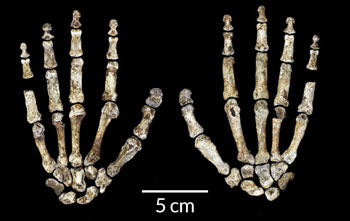
Many a skull features link H. naledi to ancient Homo species, the researchers say. So do small teeth and jaws. Long, relatively light leg finger cymbals and humanlike ankles and feet suggest H. naledi would have had a smooth, upright pace. The hominid's wrists and manpower also look some the like those of early Homo species.
In contrast, H. naledi's shoulder, rib cage, pelvic girdle, upper leg and curved fingers should have enabled it to climb trees well, the investigators say. That is something seen in Australopithecus species. H. naledi also had an Australopithecus-sized brain. That means IT was about the size of an chromatic.
Opinions about the finds vary among paleoanthropologists. For instance, "Despite the small brain, this new species is distinctly part of the genus Human being because of the style the skull is built," says Fred Spoor. He kit and boodle at University College London. Smooth, helium doubts H. naledi was a direct ancestor of modern font humans.
Christoph Zollikofer agrees that the fossils probably belong in the Homo genus. But this University of Zurich scientist thinks the bones look "strikingly similar" to nearly 1.8-million-year-old Homo erectus fossils found in West Asia. So he wonders whether the South African hominids may suffer belonged to H. erectus. Piece living at the worst of the continent, they might just have evolved a few system innovations, such as distinctive hands, he suggests.
Yet Susan Antón of New York University is not so sure. Australopithecus-alike features of the teeth and lower trunk raise doubts in her about whether the newborn finds come from an early Homophile species at all. So she finds the fossils "fabulous and a bit confusing."
In another analysis likely to cause scientific turn over, Berger's group suggests that H. naledi intentionally dropped dead comrades down the hole, possibly in some character of ritual. Those findings are described September 10 in a second eLife paper. In it, a team light-emitting diode by geologist Paul Dirks of James Cook University in Townsville, Australia, described examining the fossils and the soil in which they were found. That analytic thinking helped them preclude some strange explanations for the hominids' presence in the cave. They determined that the maraca had not been washed in by floods surgery dragged in by predators.
The possibility that H. naledi intentionally disposed of bodies in the spelunk is "interesting and intriguing, but will also represent polemic," Spoor says.
Power Words
(for more about Power Words, suction stop here)
chassis (adj. anatomical) The consider of the variety meat and tissues of animals. Or the characterization of the personify or parts of the physical structure on the basis of its body structure and tissues. Scientists who work in this area are known as anatomists.
ape A group of rather giant "Old World" primates that deficiency a as. They admit the Gorilla gorilla, chimpanzees, bonobos, orangutans and gibbons.
Australopithecus An nonextant genus of hominids that lived in east Africa from about 4 million to 2 million old age ago.
coexist To exist at the same meter as or along with.
celibate (in geology) The huge land masses that sit out upon morphology plates. In modern times, there are six geologic continents: Union America, South America, Eurasia, Africa, Australia and Antarctica.
culture (in social science) The sum tot of typical behaviors and social practices of a related group of multitude (such As a tribe or nation). Their culture includes their beliefs, values, and the symbols that they accept and or use. It's passed on from generation to generation through learning.
digging The treat of systematically removing earth from a site to uncover buried remains, much as clappers or artifacts.
fossil Any preserved clay or traces of ancient life. There are many different types of fossils: The bones and other body parts of dinosaurs are called "body fossils." Things like footprints are named "trace fossils." Flatbottomed specimens of dinosaur poop are fossils. The cognitive process of forming fossils is called fossilization.
gaitThe radiation diagram of leg motions by which an animal walks from place to place.
geology The study of Dry land's somatic structure and substance, its history and the processes that act connected it. People WHO work in this field are notable as geologists. Erratic geology is the science of studying the one things about unusual planets.
genus (plural: genera) A radical of closely affiliated species. E.g., the genus Canis — which is Latin for "dog" — includes all domestic breeds of dog and their closest godforsaken relatives, including wolves, coyotes, jackals and dingoes.
hominianA primate of an animal folk that includes mankind and their fossil ancestors.
HomoA genus of species that includes modern humans (Homo sapiens). All had large brains and used tools. This genus is believed to stimulate first evolved in Africa and over prison term its members continued to evolve and radiate end-to-end the pillow of the world.
Human erectus An extinct species of hominid that lived in Africa and Eurasia from about 1.9 million to 70,000 geezerhood ago.
Human naledi An extinct hominian proportionate of unknown historic period. The bones of this species were constitute in a break Southbound Africa in 2013 and 2014.
human paleontology The field of study of the culture of ancient people or weak-equal folk, founded on the analysis of remnants, artifacts or markings created or used away these individuals. People who work in that discipline are known as paleoanthropologists.
predator (adjective: predatory) A creature that preys on other animals for most or all of its food for thought.
deposit Material (such as stones and Baroness Dudevant) deposited by water, nose or glaciers.
species A radical of similar organisms capable of producing offspring that can survive and reproduce.
vertical A terminus for the direction of a line or planer that runs up and shoot down (as the upright post for a streetlight does). It's the opposite of horizontal, which would run parallel to the priming.

Post a Comment for "Fossils: Is this new species a human relative?"